Best Military School Coaching in Dehradun – A Complete Guide for 2026-27
Table of Contents
About Military Schools
There are a total of five Rashtriya Military Schools (RMS) across India. Every year, thousands of students apply for the Common Entrance Test (CET) to get admission to RMS. Proper preparation and guidance are needed to crack the entrance test.
The five Military Schools are located at Chail in the Shimla Hills of Himachal Pradesh, Ajmer and Dholpur in Rajasthan, and Belgaum and Bengaluru in Karnataka.
Students across the country are passionate about getting admission to Rashtriya Military Schools so that they can join the armed forces later in life and serve the country. We are here to assist students with their preparation.
Best Rashtriya Military School Coaching in India
Military School Age Criteria 2026
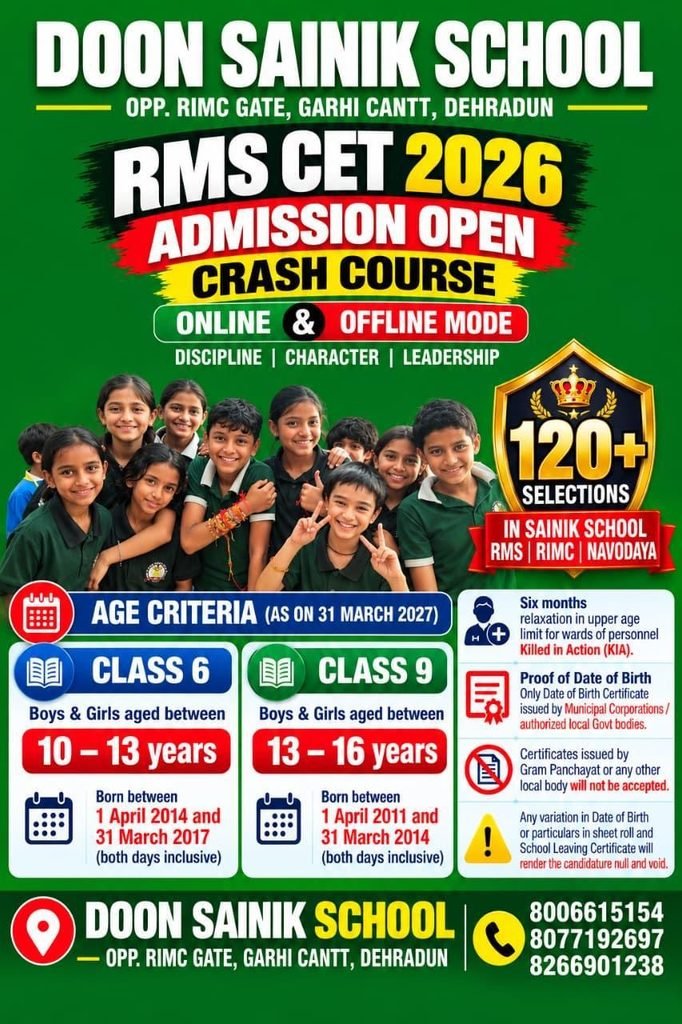
Applications are invited for admission to Class VI (Boys and Girls) and Class IX (Boys and Girls) in Rashtriya Military Schools located at Chail (Himachal Pradesh), Ajmer (Rajasthan), Belgaum (Karnataka), Bengaluru (Karnataka), and Dholpur (Rajasthan) for the academic session 2025–26.
Rashtriya Military Schools are fully residential public schools affiliated with CBSE and function under the aegis of the Ministry of Defence.
Educational Qualification
Class VI: Candidates should have passed Class V from a government-recognised school before the date of admission. Students studying in Class V are also eligible to appear for the entrance test for Class VI.
Class IX: Candidates should have passed Class VIII from a government-recognised school before the date of admission. Students studying in Class VIII are also eligible to appear for the entrance test for Class IX.
Entrance Examination
The date of the Multiple Choice OMR-based Common Entrance Test (CET) for admission to Classes VI and IX will be communicated to candidates through their registered email IDs and mobile numbers.
The information will also be available on the RMS websites:
Reservation of Vacancies
The reservation details mentioned in the document are as follows:
- 70%: Wards of JCOs/OR of the Army, Navy, and Air Force, including ex-servicemen.
- 30%: Wards of officers of the Army, Navy, and Air Force, including retired officers, and wards of civilians.
- Killed in Action (KIA): A maximum of 50 seats in all classes combined are earmarked across all five RMS schools.
- OBC (Non-Creamy Layer): 27% reservation.
- SC: 15% reservation.
- ST: 7.5% reservation.
- Girls: 10% of seats or a maximum of 30 vacancies, whichever is less, across all five RMS schools.
Best Results Military School in Dehradun
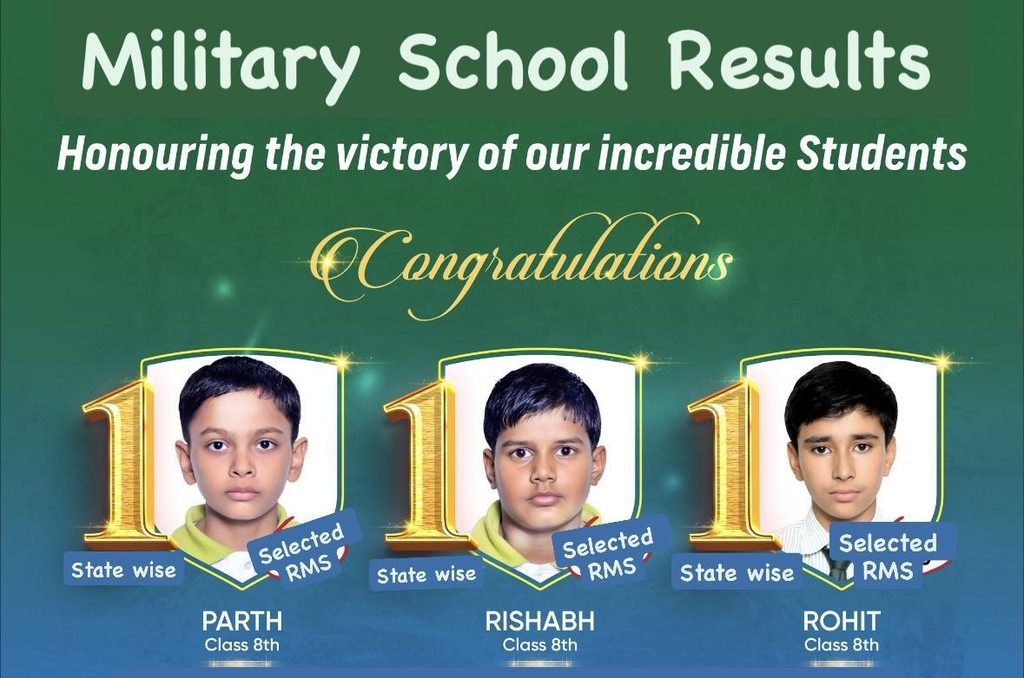
Military Schools is committed to providing the best coaching to candidates preparing for Military School examinations. With a proven record of success, our institute provides expert guidance, individual attention, and comprehensive study materials to help students perform well in competitive military school entrance examinations. Our experienced faculty members have a deep understanding of the RMS examination pattern. They use effective teaching methods that focus on both theoretical knowledge and practical application.
We provide a structured curriculum, mock tests every Saturday, and detailed performance analysis to ensure that every student is well prepared for the examination. Our supportive learning environment promotes confidence, discipline, and leadership qualities, which are essential for a successful military career.
Join one of India’s leading RMS coaching institutes and take the first step towards building your future in the armed forces. With our dedication and expertise, we aim to help students achieve excellent results.
Doon Sainik School Admission Procedure
Before taking admission to Doon Sainik School (DSS), it is important to understand that it is a private coaching-cum-residential school or academy. It is not an official Sainik School operated by the Government of India under the All India Sainik School system, nor is it an official Rashtriya Military School (RMS).
The admission process, eligibility requirements, and fees are outlined below.
Admission Procedure
Admission to Doon Sainik School (DSS) is mainly based on a written Common Entrance Test (CET). The process is relatively simple and is managed by the school’s internal team.
Steps for Admission:
- Fill Out the Application Form: Obtain and complete the admission form from the school’s official website or directly from the school office.
- Entrance Examination (CET): Students must take a common entrance examination. This examination is generally conducted during February, March, or April.
- Document Verification: After passing the written examination, the required documents are verified.
- Admission: Admission is confirmed after completing all formalities and depositing the required fees.
Other important admission requirements and stages include:
- Age Criteria
- Educational Qualification
- Entrance Examination
- Examination Schedule
- Medical Examination
Required Documents for DSS Military School and RIMC Applications
Applications must be submitted in duplicate. The mandatory documents that must be attached to the application form are as follows:
- Birth Certificate: Issued by the Municipal Corporation or Gram Panchayat.
- Domicile Certificate: Certificate of the candidate.
- Category Certificate: SC/ST certificate, where applicable.
- School Certificate: A certificate from the principal of the school where the candidate is currently studying. It must include an attested photograph, the date of birth as recorded in the school’s records, and the class in which the student is studying. The original certificate must be submitted.
- Aadhaar Card: A photocopy of both sides of the candidate’s Aadhaar Card is mandatory. According to the document, the application will be rejected if this requirement is not fulfilled.
- Photographs: Two passport-size photographs.
- School Documents: Original School Transfer Certificate (TC), School PAN Number, UDICE Number, and report card.
Note: The document states that the application form should reach the respective State Governments, as specified in the admission guidelines, by 31 March 2026.
Military School Syllabus 2026 for Classes 6 and 9
Class VI Syllabus
1. English
- Antonyms
- Synonyms
- Prepositions
- Composition
- Framing Questions
- Articles
- Comprehension Passages
- Affirmative and Interrogative Sentences
- Fill in the Blanks
- Spelling Check
- Affirmative and Interrogative Sentences
- Jumbled Paragraphs
- Sentence Construction
- Error Correction
- Types of Sentences: Negative, Interrogative, Positive, and Exclamatory
2. Intelligence Test
- Relationships
- Analogy Relationships
- Classification
- Sequences
- Verbal and Non-Verbal Reasoning
- Image-Based Questions
- Completion of Series
- Jumbled Spelling
- Direction Sense
- Analogy Test
- Puzzles
- Coding and Decoding
- Analogy Test
- Decision-Making
3. Mathematics
- Number System: LCM, HCF, place values, smallest and greatest numbers, rounding off, number series and patterns, BODMAS, squares, square roots, prime factorisation, etc.
- Time and Work
- Percentages
- Profit and Loss
- Degree Fahrenheit
- Simple Interest
- Arithmetic Mean
- Measurement of Temperature in Degree Celsius
- Arithmetic Mean
- Decimals and Fractions: Fundamental operations, conversion of fractions to decimals or percentages, simplification, comparisons, equivalent fractions, etc.
- Mensuration: Units of area and volume, area and circumference of a circle, perimeter and area of triangles, rectangles and squares with diagrams, volumes of cubes and cuboids, etc.
- Geometry: Basic geometry, including lines, points, line segments, rays, circles, angles, quadrilaterals and polygons, interiors and exteriors of figures, triangles, and construction of line segments.
4. General Knowledge and Current Affairs
- History
- Sports
- Awards
- Science and Health
- Committees and Commissions
- States of India
- Our Defence Forces
- Atomic Power Stations in India
- Classical Dances of India
- Books and Authors
- International Organisations
- Indian Constitution
- Environment and Pollution
- General Science
- Important Events of World History
- Inventions and Inventors
- Common Abbreviations
- Important Towns on Rivers
- Countries, Capitals and Currencies
- National Parks and Wildlife Sanctuaries in India
- Union Territories
- Famous Rivers
- Geography
- Famous People and Places
- Important Dates and Days
Class IX RMS CET Syllabus
Paper I
A. English Syllabus
- Grammatical Structure
- Comprehension and Passages
- Antonyms
- Synonyms
- Vocabulary
- Prepositions
- Composition
- Homonyms
- Framing Questions
- Articles
- One-Word Substitution
- Comprehension Passages
- Affirmative and Interrogative Sentences
- Fill in the Blanks
- Spelling Check
- Error Correction
- Grammar: Verbs, Adjectives, Nouns, Gender, Sentence Structure, etc.
B. Hindi Language and Grammar Skills
The syllabus includes the following language skills and grammar topics:
- Letters and Spelling: Understanding letters and correct spelling.
- Idioms: Understanding and using idiomatic expressions.
- Parts of Speech in Context: Identifying the grammatical role of words in sentences.
- Proverbs: Understanding commonly used sayings and proverbs.
- Sentence Transformation: Changing sentences between simple, compound, and complex forms.
- Word Usage: Understanding subtle differences in word meanings and usage.
- Word Categories and Origins: Understanding word groups and their origins.
- Identification of Grammatical Categories: Recognising different parts of speech.
- Synonyms
- One-Word Substitution for a Phrase
- Antonyms
- Reading Comprehension Passages
- Correcting Grammatically Incorrect Sentences
- Sandhi and Samas: Rules of joining sounds and forming compound words.
C. Social Science
- History
- The First Cities
- The First Farmers and Herders
- When
- Where and How
- New Ideas, Culture and Science
- New Kings and Kingdoms
- Regional Cultures
- Geography and Agriculture
- Resources and Types of Natural and Human Resources
- Diversity
- Political Science
- Regional Cultures
- The First Farmers and Herders
- Social Justice and the Marginalised
- Understanding Gender
- State Government
- The Judiciary
- Environment in Its Totality
- Natural and Human Environment
- Air and Planet Earth in the Solar System
- The Globe
- Geography as a Social Study and as a Science
- Challenging the Caste System
- Rural Life and Society
- Political Development
- Sultans of Delhi
- Creation of an Empire
- Regional Culture
Paper II
A. Mathematics
- Number System: LCM, HCF, place values, smallest and greatest numbers, rounding off, number series and patterns, BODMAS, squares, square roots, cubes and cube roots, prime factorisation, conversion of fractions to decimals or percentages and vice versa, etc.
- Roman Numeration and Rounding Off Numbers
- Comparison of Numbers
- Greatest and Smallest Numbers
- Unitary Method
- Ratio and Proportion
- Time, Work, Distance and Displacement
- Lowest Form and Equivalent Fractions
- Profit and Loss-Based Problems
- Circles and Their Parts
- Basic Geometrical Concepts Such as Points, Lines, Line Segments, and Rays
- Classification of Angles
- Angles, Triangles, Circles, etc.
- Angle Sum Property of Triangles and Quadrilaterals
- Areas of Triangles, Rectangles, Squares, etc.
- Volume of Cubes and Cuboids
- Area of a Circle
- Triangles, Quadrilaterals and Polygons
- Conversion of Units of Area and Volume
- Interiors and Exteriors of Given Figures
- Place Value and Face Value of Numbers
- Temperature Measurement in Degrees Celsius and Degrees Fahrenheit
- Angle Sum Property of Triangles and Quadrilaterals, etc.
B. Science
- Reproduction
- Food
- Chemical Effects of Electrical Current
- Electroplating
- Solar System
- Natural Phenomena
- Energy
- Light
- Living and Non-Living Things
- Materials, etc.
Reservation for Rashtriya Military Schools
The document also lists the following reservation details.
Category-Wise Reservation
- JCOs/OR: 70% for serving and retired personnel of the Army, Air Force, and Navy.
- Officers: 20% for serving and retired officers of the Army, Air Force, and Navy.
- Civilians: 10%.
If seats remain vacant, they may be offered to candidates in the civilian category during the same academic year.
Reservation as per Government of India Policy
The following reservation applies to all the categories mentioned above:
- OBC NCL: 27%
- SC: 15%
- ST: 7.5%
Reservation for Killed in Action (KIA) Candidates
A total of 50 seats, with not more than 15 in either school as stated in the document, are earmarked for wards of personnel killed in action. This provision applies to the wards of Army, Air Force, and Navy personnel.
Reservation for Girls
Ten per cent of seats or a maximum of 30 seats, whichever is less, across all five RMS schools, are reserved for girls.
The document also mentions 10% of the total seats across all five RMS schools for the current CET.
Rashtriya Military Schools (RMS) CET Result 2025
The document includes a section titled “Rashtriya Military Schools (RMS) CET Result 2025 – Check Details.”
About Doon Sainik School
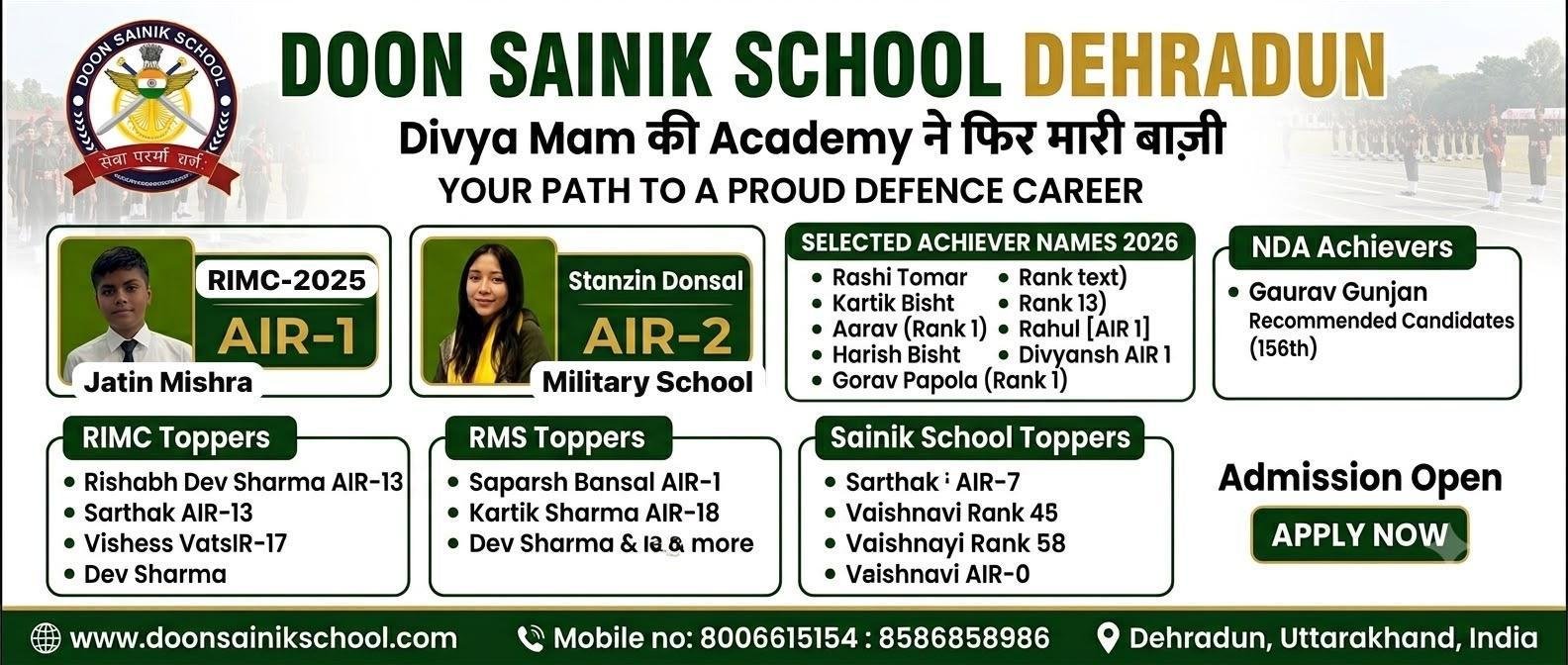
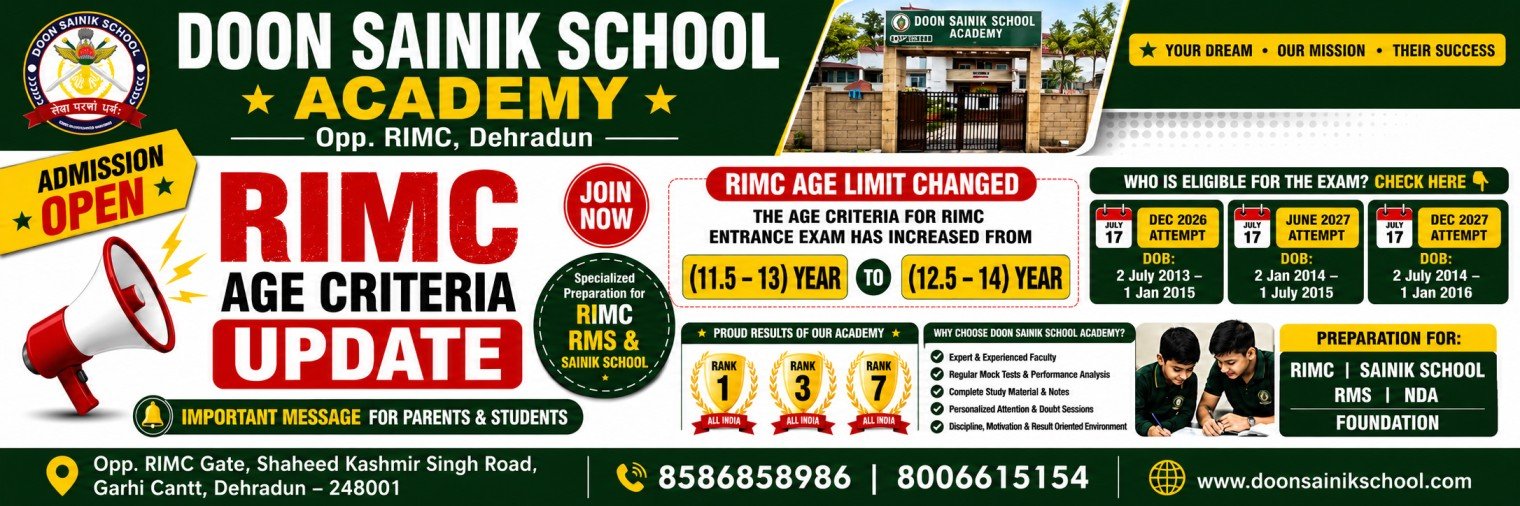
Doon Sainik School was established in 2010. Its founder is Divya Soni Ma’am, who has also served as a course mentor at HRDC 42 Brigade. Doon Sainik School is a trust and society that provides coaching for Sainik School, Military School, and RIMC entrance examinations. Along with coaching, the institution also provides schooling and boarding facilities for both boys and girls from Class 2 to Class 12.
Separate hostels are available for boys and girls.
For the Military School batch, the institution admits only 30 students, including 20 boys and 10 girls. Students must take an entrance examination, and admission is granted only after they clear the entrance test.
For more information, you can contact the institution at:
Contact Number: 8586858986
Important Notice: Several people have created duplicate academies using our name. Therefore, please confirm by phone before visiting so that you are not misled.
Best Online/Offline Coaching for Sainik School, RMS, RIMC and NDA After 10th Class
Call: 8006615154
Address: Opposite RIMC College, Near Shivalik Homestay, Dehradun.
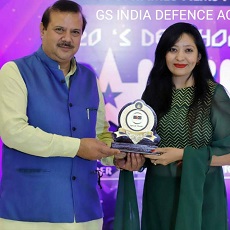
Principle Mam
It is a matter of great pride for the School that Smt Divya Soni, MA.(Public Add,Geography) BEd, PGCTE (Assistant Master) was honored with the National Award for Teacher's, 2011 & The Indian Education Award 2019 . The award was presentedto her at New Delhi on the occasion of the Teachers Day, by her Excellency, Smriti Zubin Irani is an Indian politician.